
San Luis Obispo Recent Arrests
The San Luis Obispo County Sheriff's Office publishes two separate public tools. One is the Booking Log. It reports new county jail bookings. You can filter results by date, time, and arresting agency. The other is the Who's In Custody search. It answers a different question: who is still being held right now. Expect at least a one-hour delay before a new booking appears. City arrests can lag further behind. Some citations or quick releases never become county bookings at all. Those limits are worth knowing when you are checking who was arrested in San Luis Obispo.
The two booking windows serve different purposes. The Arrests Last 24 Hours page covers the rolling same-day view. The Police Blotter page covers the multi-day data and where older records end up.
Official systems and source availability reviewed September 6, 2026.
Read the timestamps before comparing anything. The date and hour you select mark the end of a rolling day. That point is not the start of an open-ended search. A booking can fall just outside that window. It will not show up, even if it feels recent. Agency filters can hide results too. Another department may have made the arrest. So start broad with all agencies, then narrow things down. If timing matters, check the roster as well and call the jail. Once public web history rolls away, a formal records request is the durable route.
| Official view | Window and purpose | Photo treatment |
|---|---|---|
| Booking Log | Selected endpoint plus the preceding 24 hours; at least one hour delayed | No photo column |
| Raw booking data | About 30 days observed on September 6, 2026; depth is not guaranteed | No gallery |
| Custody search | Current jail status rather than a fixed arrest window | Photo availability is conditional |
The official Booking Log screen shows the county's one-day controls and delay notice.
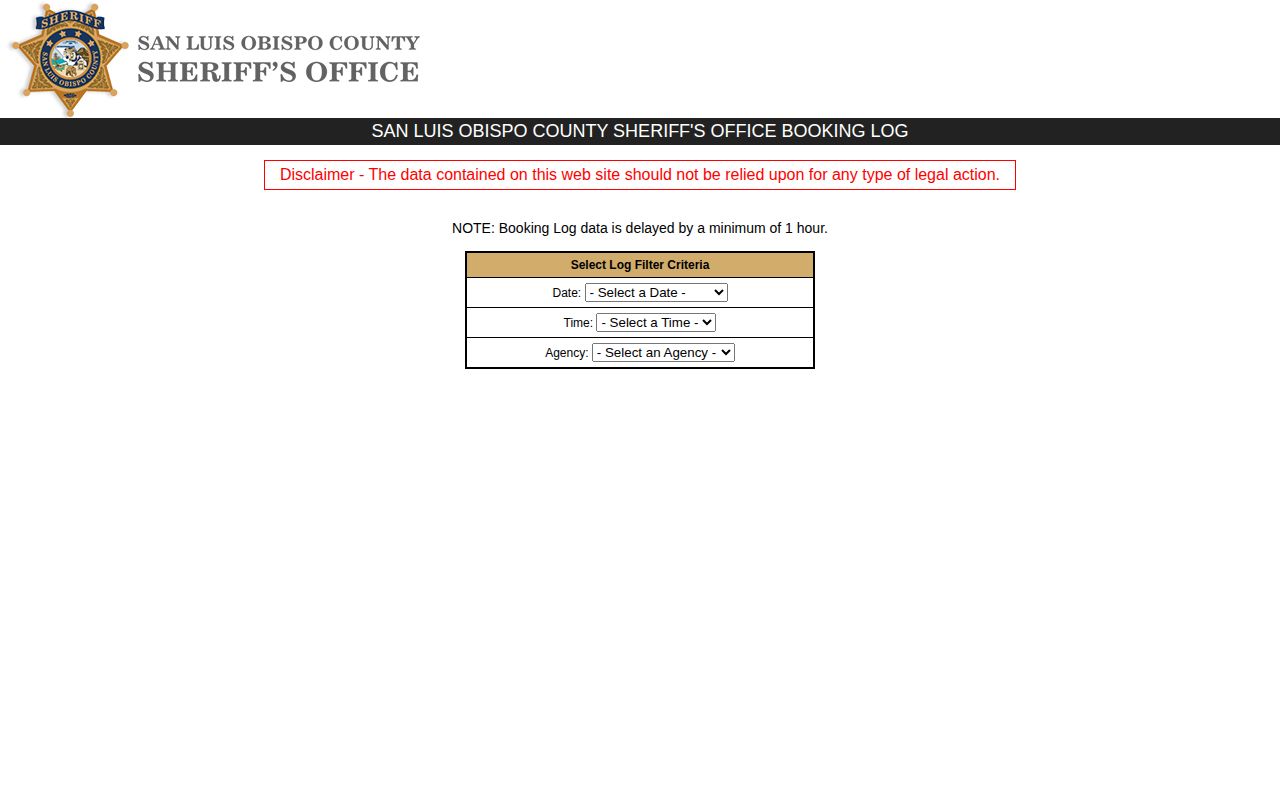
This shows the jail's booking interface. It lists San Luis Obispo arrests. It is not a gallery. Booking data appears here.
Search the County Arrest Roster
The roster spans the whole San Luis Obispo County Jail system. That population includes both pretrial arrestees and people already sentenced. So a current listing is not always a recent arrest. Always check the booking date before assuming otherwise. Names can also drop off after a release, transfer, or correction. A missing name does not rule out an arrest. One quirk sits in the official URL itself. It uses the odd spelling so-intergration, so keep that link exactly as published.
| Search field | What it narrows |
|---|---|
| Inmate ID or booking number | A known jail or booking identifier |
| Name | Possible identity matches |
| Gender, birth date, or age | Matches that share a name |
| Booking date | The intake event date |
| Projected release date | A forecast that may change |
| Bail | The amount recorded by the source |
Search narrowly and compare every identifier. Open a likely match. Read the booking time, charges, bail, arresting agency, and projected release fields. Court records pick up the story after that. The Sheriff's own warning notes that booking charges and bail can change. Do not lean on them for legal action.
A practical search starts with the most specific identifier you have. The official form accepts booking numbers and inmate numbers alike. A name search can pull up more than one person. Compare birth dates or ages inside the official tool only. Keep those sensitive details to yourself. Remember that a booking date marks jail intake, not the moment of the street arrest. A projected release date is simply a planning field. It can move after a court order, bond decision, hold, or transfer. If a result looks off, note the source time. Then call the jail information line instead of trusting a single field.
The official custody-search form shows the full range of identity and custody fields.
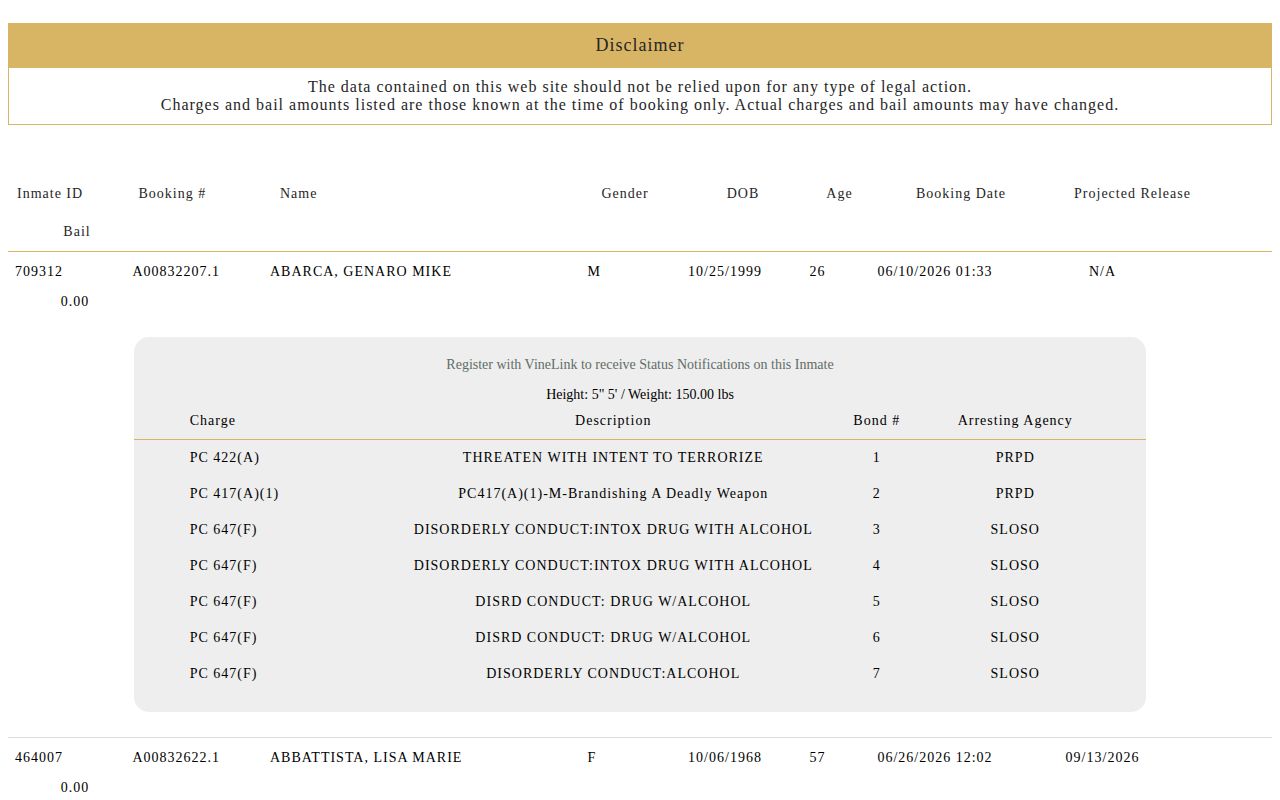
Use those fields to distinguish matches without treating a roster entry as a conviction.
San Luis Obispo Sheriff App
The Sheriff's office also runs a mobile app. It is the official San Luis Obispo CA Sheriff app. It carries public-safety news, press releases, inmate information, and alerts. Think of it as another door into agency information rather than a standalone booking database. The county announcement also mentions a past Most Wanted Wednesday feature. App screens change over time. The web roster and Booking Log therefore stay the primary booking sources.
A custody result may offer VINE registration. San Luis Obispo County rides the statewide California VINE route. The county appears in the older brochure's statewide coverage rather than its separately branded list. The VINELink Custody Check page explains how to follow one custody record. It also covers how to set up alerts. Treat notifications as information, not court notices.
The official app listing identifies the Sheriff's mobile channel.
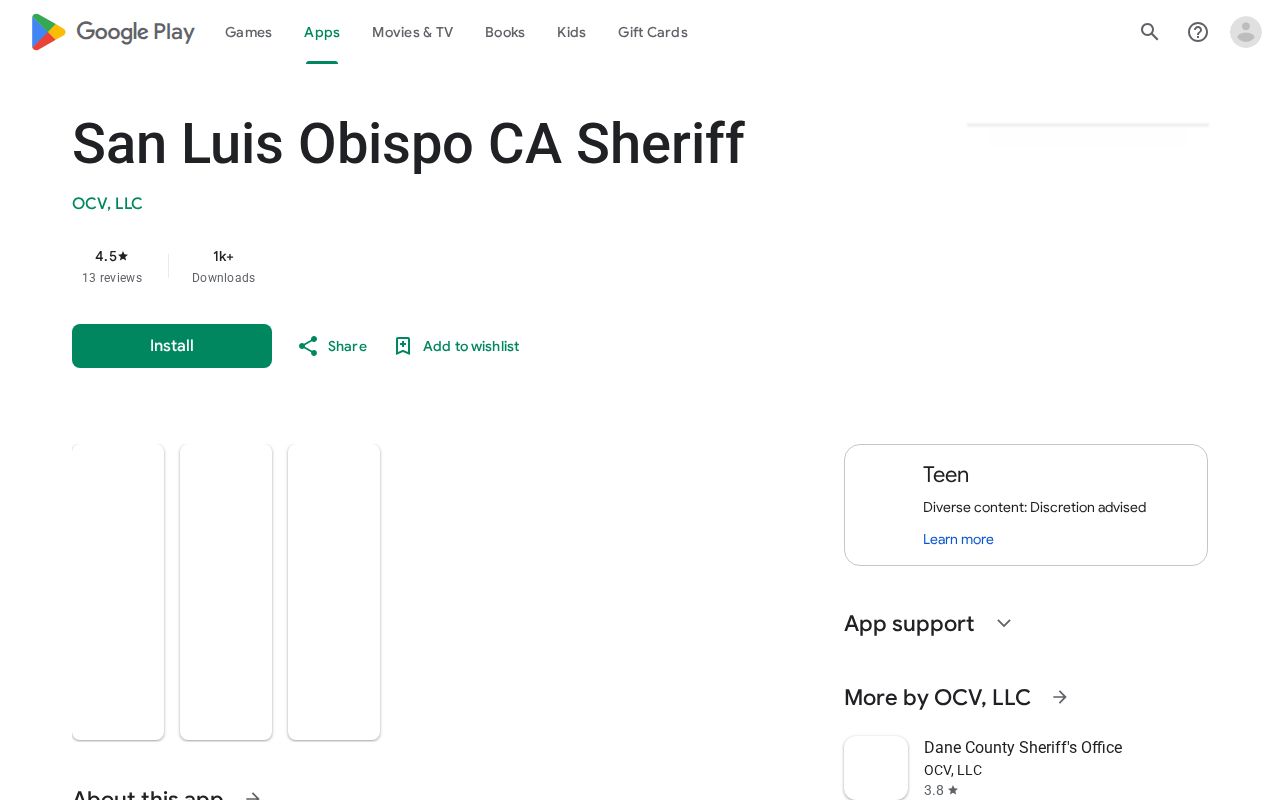
The listing helps confirm the app's publisher and scope before installation.
San Luis Obispo VINE Route
The VINE link inside the Sheriff roster ties a local custody result to notification signup. Older DA material places San Luis Obispo in California's statewide "all other counties" route. It is not among the named local programs. That points to the statewide VINELink service, not a county-branded SAVIN portal. Searching and registering still depend on the identity fields. They also depend on the current custody data fed to the service.
San Luis Obispo Booking Sources
Official sources belong at the front of every search. City logs can supply incident context. News outlets and commercial indexes come later, since they tend to be selective, stale, or incomplete.
| Channel | Official? | Best use |
|---|---|---|
| Sheriff roster | Yes | Current county custody |
| Sheriff Booking Log | Yes | New booking events and arresting agency |
| City police logs | Yes | Calls and incident context |
| Sheriff news/app | Yes | Selected agency announcements |
| Local news | No | Event reporting, checked against primary records |
| RecentlyBooked or Mugshots.com | No | Discovery only; coverage may persist or conflict |
Newsrooms across San Luis Obispo County follow arrests closely. The Tribune crime desk and KSBY Local News report bookings and police activity, while smaller outlets cover their own corners of the county. That includes Atascadero News, Paso Robles Daily News, New Times, and Cal Coast News. One limit applies to all of them. Reporters choose which arrests to cover, so no outlet lists every booking. The Tribune also keeps a historical mugshot archive, and that archive is not a live custody roster.
Commercial sites fill a different niche. RecentlyBooked's county page and the Mugshots.com California index collect booking photos from many counties. Neither speaks for the Sheriff. RecentlyBooked's live county display and its older subject pages can disagree on coverage. Mugshots.com entries also linger after an official feed rolls off. BustedNewspaper and Mugshots.zone list no San Luis Obispo County page here, and Arrests.org returns nothing county-specific. Those gaps can change.
Timing matters as much as the source. A police statement can land before jail intake. A city activity log may post on its next business day, and a news story can trail the arrest by weeks. Commercial pages can also outlive custody. Before treating two entries as one arrest, compare the agency, the booking date, and the case reference. For who is in custody now, go back to the Sheriff. For the legal outcome, the Superior Court decides.
Recent Arrests by City
City police logs and county bookings answer different questions. San Luis Obispo Police posts a weekday activity log. Weekend material shows up on Monday. Paso Robles Police keeps daily incident logs plus historical monthly groupings. Atascadero Police routes record requests through its Records Bureau, and an internal procedure mentions a weekly log that is not a current public archive.
- San Luis Obispo Recent Arrests connects SLOPD activity with county jail intake.
- Paso Robles Recent Arrests reconciles PRPD incident logs with Sheriff booking data.
- Atascadero Recent Arrests explains the APD records-request route and county custody search.
The arresting-agency field shows which department made each arrest, even when booking happens at San Luis Obispo County Jail. City arrests show up here. A city officer can still book into the county jail. The field keeps it clear.
San Luis Obispo Arrest Fields
A booking record captures intake only. It is not the court file. The rendered log and the underlying XML can expose different depth, so note which source supplied a fact. Field meanings stay the same either way.
| Field | Meaning |
|---|---|
| Booking and inmate numbers | Administrative identifiers for an event and person |
| Booking date and time | Jail intake, which may differ from arrest time |
| Charge code and description | Charges recorded at booking |
| Agency and arrest location | Who brought the case and the source-recorded place |
| Bail or bond | A booking-time figure that may change |
| Facility and active status | Custody fields, not court outcomes |
| Docket and next court date | Links to verify with the court |
| Projected release | An estimate, not a promise |
The charge field shows what officers cited at the time of booking. It comes straight from the intake record.
Several fields look more settled than they are. "Active" describes a state in the booking data, nothing more. A bond number is just an administrative reference. Bail amounts can move. The arresting agency shows who supplied the booking, not which office will prosecute the case. Court and department fields can help locate a calendar entry. The court still controls its own docket. A release manner, when a record request surfaces one, says nothing by itself. It won't say whether a charge was filed or sustained.
- Booking
- The jail intake process and record created after a person is brought to custody.
- Arraignment
- An early court appearance addressing the charge and plea.
- Disposition
- The court's outcome, which may differ from the booking charge.
- Expungement
- A form of record relief with effects defined by California law.
County Mugshots and Arrest Photos
The county publishes no public mugshot gallery. A separate Booking Photo template handles images one record at a time. It may display a photo for a specific booking. It may also return "Mugshot Image not available." Either way, the template supplies a Sheriff request route for the image. That design supports record-by-record inquiry rather than mass republishing. California law also limits law-enforcement sharing of booking photographs on social media. Those limits are subject to defined public-safety and legal exceptions. The Sheriff's official booking-photo template shows how this conditional process works.
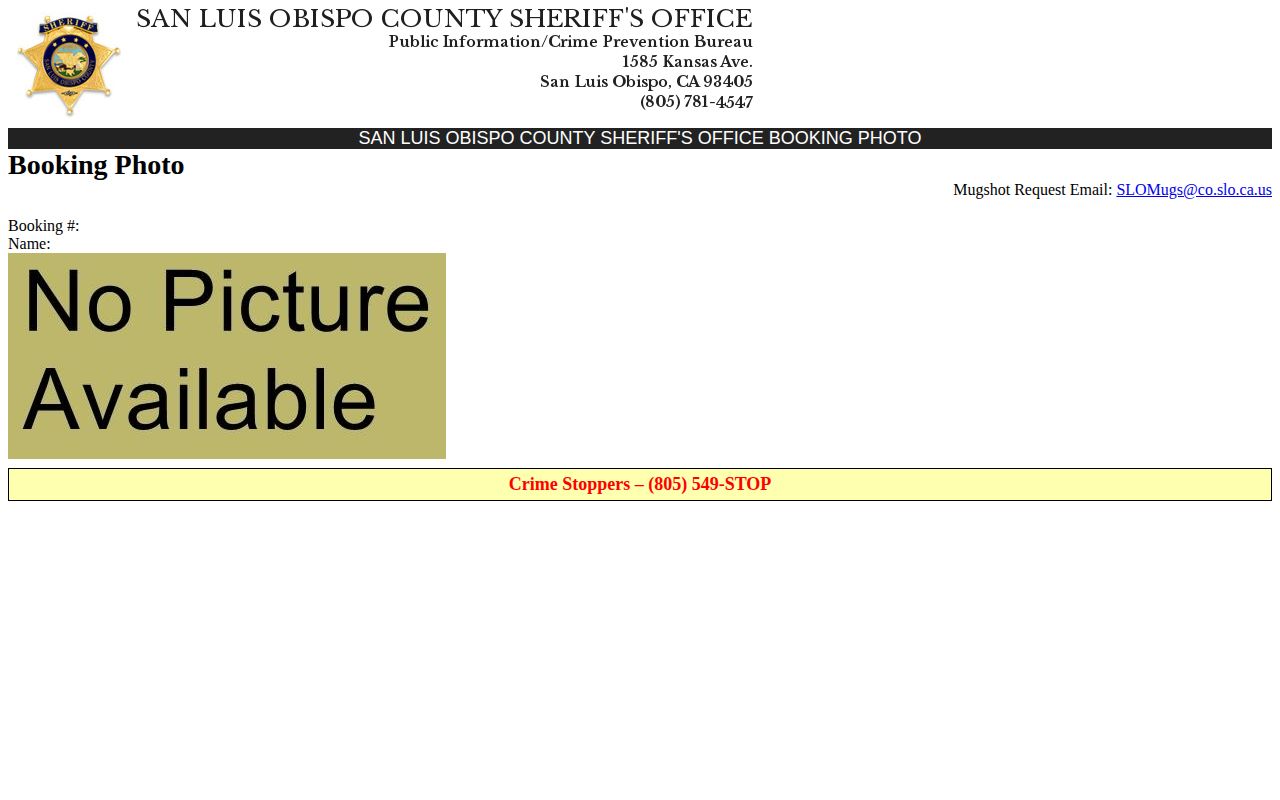
The template is a request form. It is not a booking photo. A CDCR photo is a state-prison record, not a county mugshot substitute. Third-party images can stay visible after the official feed changes. Start with the agency that created the record.
Request San Luis Obispo Booking Records
The county PRA/Data Requests page routes each record type to the responsible department. Inmate, arrest, and custody records start there. Criminal, warrant, emergency-call, camera, and coroner records start there too. Ask narrow. A focused request is easier to locate than a broad demand. The county sets no single fee or delivery period for every record.
- Name the Sheriff's Office and the exact record type, such as a booking record or one booking photo.
- Give a narrow date range, name, location, and case, incident, or booking number when known.
- Ask whether the record exists and is disclosable, plus any copy or review cost.
- Keep the agency response and use its clarification route if the request needs more detail.
California Government Code §7922.535 sets a clock. The agency generally owes a disclosure determination within ten days. Written notice can add fourteen more days for unusual circumstances. The extension must be in writing. Timing varies. Copies may lag behind the determination, since search, review, consultation, and lawful redaction all take time.
Direct jail records to the Sheriff. City police departments hold their own incident reports. The Superior Court is the source for public court documents, but its request form excludes police reports, arrest reports, incident reports, warrants, transcripts, and confidential files. A reply may cite an exemption, call for redaction, or point to another office. Want a single booking photo? Describe one event and ask whether the image exists and can be released lawfully. Bulk requests for names or faces do not fit that record-specific path.
California Booking Photo Law
California keeps tight rules on booking photos. The Attorney General's booking-photo alert explains those limits under Penal Code §13665. It also cites Civil Code §1798.91.1, which defines a booking photograph. Law-enforcement sharing is allowed only in narrow situations. The exceptions cover violent crimes, fugitives, imminent threats, court orders, and urgent police needs. None of this makes every photo public. It also does not bar lawful access to records.
A second state law offers a petition path. Penal Code §851.91 lets a person ask a court to seal an eligible arrest that ended without conviction. Sealing differs from a conviction dismissal. It also will not make copied news pages or private sites vanish overnight. Corrections begin with the original publisher. Google provides a free outdated-content refresh once a source page is removed or materially changed. Avoid anyone selling guaranteed erasure of an official record or search result.
If a San Luis Obispo County Sheriff record is wrong, send the proof to the Sheriff. A search engine should not settle official facts. The refresh tool updates an old result or snippet after a publisher changes its page. That tool never deletes a live page. Private publishers may run their own free correction or opt-out process, so use only the route they document and keep copies of each request.
San Luis Obispo Booking Archives
Booking records released by the Sheriff are archived electronically under the office's retention schedule. No fixed public feed window is promised. The roughly 30-day span in the raw data is a web snapshot. It is not the agency's legal retention rule. Older records can go several places. An archived San Luis Obispo County booking file might sit with the Sheriff. It could move into another county system or transfer elsewhere. It could also be lawfully destroyed. Ask before assuming. State Archives guidance does not prove any specific booking file was deposited there.
Adult County Booking Scope
These public routes cover adult county custody only. Juvenile cases are separate. They receive far stronger privacy protection. City procedures may redact or exclude juvenile details. A missing juvenile name on an adult roster proves nothing about an incident. Citations, releases before county intake, and placements in other custody systems also sit outside a simple adult-jail search. That boundary keeps the roster from being a complete list of every arrest made in San Luis Obispo County.
County Arrest Warrants and Wanted Notices
Start with the Superior Court's warrant instructions. They are the safest check. An inquiry pairs a name with a case number or date of birth. From there, the court's options may involve a calendar date, bail, or surrender. The Sheriff Records and Warrants Unit may share limited adult warrant details. A warrant is an order with a status. That status can be recalled, served, stayed, or changed.
Most Wanted Wednesday ran through the Sheriff's app and records staff, while Crime Stoppers preserves a historical public-tip route. Those posts age fast. Check dates and current official sources rather than copying names into a permanent list. Never approach, contact, or follow a wanted person. Call 911 for an emergency and use the official tip or non-emergency channel otherwise. The court's current warrant page shows the official inquiry and resolution route.
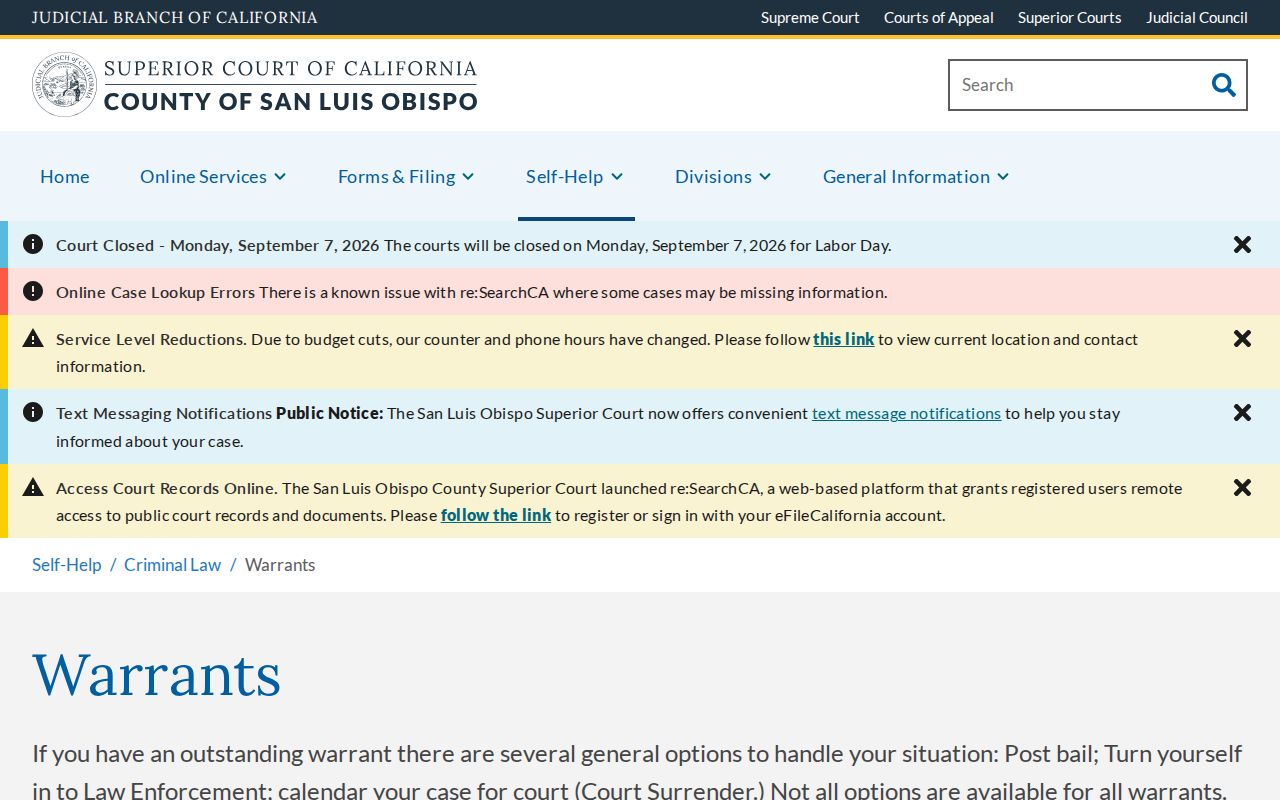
The captured instructions avoid the risk of relying on a stale wanted post.
After a County Arrest
Arraignment is the first court appearance. Charges and rights are addressed there. Bond is a financial or legal release condition. A disposition is the court's final result. The San Luis Obispo Superior Court Criminal Division handles local infractions, misdemeanors, and felonies. re:SearchCA offers remote access to many public court documents, though some case information may be missing from that view.
The court clerk's criminal-information form has clear limits. It cannot supply police reports, arrest reports, incident reports, warrants, transcripts, or confidential documents, which stay with their proper agencies and processes. Booking XML may hold a docket number or a next court date. Court dates move, so verify the court file before drawing conclusions.
Custody Outside San Luis Obispo County
Custody does not always stay local. The CDCR CIRIS search tracks people held in California state prisons. It returns a CDCR number and the facility. Admission details, the commitment county, and a parole-eligible date also appear. California Men's Colony sits in San Luis Obispo itself. Still, it is a state prison, not a county booking facility. Its population never appears on the jail roster. A move into CDCR custody may also require a fresh victim-notification registration.
Other systems sit outside county records too. The federal Bureau of Prisons locator lists inmates back to 1982. It shows no booking photos. ICE keeps its own detainee locator. It needs an A-number plus country of birth or exact identity details. The Marshals Service runs JDIS, but that system stays restricted. Someone can leave San Luis Obispo County custody without ever generating a new county booking. County jail, state prison, federal, immigration, and juvenile custody are separate worlds. Blending them leads to wrong answers.
Each boundary changes what an empty result means. CIRIS will not list an ordinary pretrial detainee held at county jail. The BOP locator cannot cover federal pretrial cases or every contract placement. ICE sets its own identity rules and custody practices. Juvenile cases stay protected and out of any adult booking map. If custody seems to have shifted, confirm it first. Ask the agency that last held the person. Then check the receiving system's locator. A missing county entry alone tells you nothing about where someone went.
Which source should confirm release? The county roster answers current jail status. VINE sends alerts. The right state or federal locator takes over once a transfer is documented. Direct agency verification is the safest final step.
San Luis Obispo County Sheriff’s Office Location and Directions
Public Record Search
Sponsored Results