
SLO County Arrest Log History
The Sheriff's Booking Log is the county's official multi-day source. Behind it sits a WebBookingLog XML feed carrying the raw entries. Booking dates in that feed reach back roughly 30 days. That span is not a promise. The oldest date can shift as records roll off, corrections land, or the system changes. So a month of history is never guaranteed online.
A wider span helps after a holiday weekend. You can review several booking dates. No single 24-hour endpoint has to carry the whole record. The Sheriff still states a minimum one-hour delay before entries appear. Coverage also stops at the county jail system. Citations, juvenile matters, releases before booking, and arrests routed to other custody never reach this blotter.
Read the SLO Arrest Blotter
Dates and source fields are the map. Work backward from the most recent booking dates. Keep one distinction in mind: the booking timestamp marks intake at the county jail, which can lag the moment an officer made the arrest. The steps below hold those two events apart.
- Open the official Booking Log or raw XML source.
- Start with the newest booking date, then work backward across the period in question.
- Match booking number, agency, and arrest location before relying on a name match.
- Read charges as charges recorded at intake, not as the filed or final court result.
- Check the Superior Court when a docket or next-court field needs current confirmation.
The raw feed is built for machines, not readers. Still, it can expose fields the polished report leaves out. Need a single tight day instead? The San Luis Obispo County Arrests Last 24 Hours page covers that endpoint. It also carries its instructions. The multi-day method suits runs of booking dates and older entries inside the rolling feed. The official XML feed shows the structure behind the county blotter.
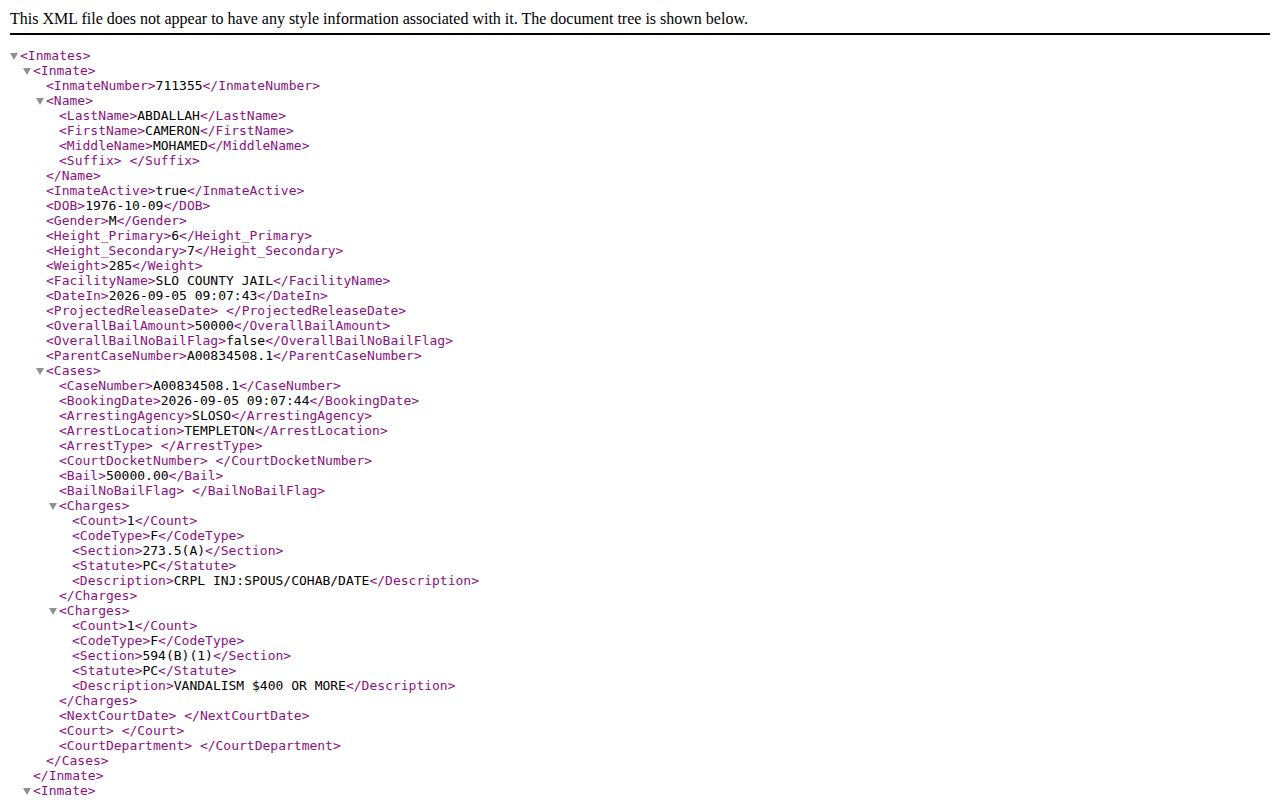
The San Luis Obispo blotter is built for structured data. It is not a photo gallery. Nor is it a permanent archive.
SLO Arrest Log Entry Fields
The rendered log and the XML overlap. They are not twins, though. Tie every field to whichever source actually displays it, since the two formats do not match perfectly. Blank court or bail fields should stay blank rather than be filled by guesswork.
| Field | How to read it |
|---|---|
| Booking number and inmate ID | Administrative identifiers used to distinguish a booking and jail record. |
| Booking date/time | The intake timestamp, not necessarily the moment of arrest. |
| Agency and arrest location | The office and place associated with the booking case; neither field alone identifies the jail. |
| Charge code and description | Charges known at booking. Later filing and disposition belong to the court. |
| Bail or bond | A source-time amount or identifier that can change after a court decision. |
| Active status and facility | Underlying custody fields, not proof of guilt or final case status. |
| Docket, court, next date | Links or calendar data when populated; confirm changes with the court. |
The raw feed digs deeper than the rendered report. It can list arrest type, count, felony or misdemeanor coding, parent case, projected release, and individual charge records. Those details add provenance to each entry. A projected release date can still change. An inactive record tells you nothing about whether the person was released, transferred, or simply hit by a data update.
SLO Weekend Arrest Log Timing
Nothing official fixes a weekend or holiday refresh schedule. The one-hour figure is only a floor. Intake workload, transport from a city, record review, corrections, and technical changes can all delay when a booking shows up. A late-weekend arrest may post well after the fact, so a Monday search can call for more than one endpoint or date.
City logs run on separate clocks. San Luis Obispo Police posts weekday logs Monday through Friday and posts its weekend log on Monday. Paso Robles keeps daily Police Incident Logs with monthly archive groupings. Atascadero offers public-record and activity-log routes. It lists no current public arrest-log archive, though. Those city logs add incident context, but the Sheriff booking feed remains the county's core arrest record.
Note: Search adjacent booking dates after a weekend and compare agency fields before deciding that two entries describe the same event.
SLO Arrest Archives and Requests
The Sheriff Custody Manual sets the rule. Booking-unit records are archived electronically once a person is released, then follow an established retention schedule. No universal web-retention length is published. Online rolloff, agency retention, legal holds, and public-records access are separate questions, each needing its own answer. A record missing from the feed may still sit with the Sheriff, though confirming that takes a formal request.
Older records start at the county PRA/Data Requests page. Name the agency and record type first. Add the date range, location, and any booking, case, or incident number. Say exactly what you need, because booking metadata, a custody record, a booking packet, and a single photograph each travel different paths. Ask whether the record is still in the Sheriff system, archived, transferred, or destroyed under an approved schedule.
Other archives have limits. The California State Archives offers local-government retention guidance, but it holds no known San Luis Obispo Sheriff booking records. The Superior Court covers another lane. It can supply eligible court documents and case information, yet its criminal request form expressly excludes police reports, arrest reports, incident reports, and warrants. The county recent-arrest overview sorts those routes apart.
Search engines add their own timeline. A result can linger after the official page changes. A stale snippet is not an agency archive. If a government record has been corrected, the originating office confirms it first. A search engine refreshes an obsolete result only after the source changes, and it never rewrites the Sheriff's record.
Extra SLO Arrest Data Fields
The XML feed carries far more than the visible columns suggest. Bail amounts sit alongside arrest type, arresting agency, and facility fields. Court docket numbers and next court dates are there too. Active status and charge metadata round out the record. That depth makes the log genuinely useful. A docket number can point you toward a case file. The court itself is still the only place with the current calendar and final outcome.
The agency field also clears up a local puzzle. SLOPD, PRPD, APD, the Sheriff, or CHP can all make arrests in San Luis Obispo County. Yet the county jail handles every adult booking. So an arrest location tells you nothing about where a person is held. One more wrinkle exists. California Men's Colony is a CDCR state prison inside the county. Its inmates never appear in this booking log.
SLO Arrest News Is Selective
News coverage fills in color that a roster never will. But it works by a different logic. Outlets chase events. A major investigation, a public warning, or a sheriff's press release gets a story; a routine overnight booking usually gets skipped. One local outlet prints arrest-related agency releases often. The Paso Robles Daily News covers its corner of San Luis Obispo County.
Bail and charges often make the first story. Later dismissals, releases, or amendments rarely earn a follow-up. Old headlines can linger in search results. Booking photos do too, long after the official feed has moved on. The Tribune runs a crime section plus a historical Mug Shots archive. KSBY covers Central Coast public safety. New Times, Atascadero News, and Cal Coast News each publish dated county stories. Treat all of it as leads. Sheriff and court records come first for anything that matters.

Context is where news shines. The Cal Coast News site is another independent channel covering San Luis Obispo County arrests. Still, the Sheriff log remains the booking record of authority. Read the stories for the story.

Independent coverage should be checked against the arresting agency and current court record.
Keep four dates straight when checking an archive. Note the incident date, the arrest time if given, the county booking time, and the publication date. They rarely line up on the same day. Booking number plus arresting agency is the pairing that reconciles entries. The court confirms anything that happened afterward. Has the online data rolled off? Request the exact date range and record type from the Sheriff. The agency may report the record was archived, corrected, withheld, transferred, or lawfully destroyed. An empty search result alone proves none of those things.
Public Record Search
Sponsored Results