
How Paso Robles Arrests Work
Arrests in Paso Robles can start on a city street. They can end in a county cell. A Paso Robles Police Department officer writes the city incident record after a call, citation, or arrest. Once an adult enters county custody, the San Luis Obispo County Sheriff opens a booking record. It sits at the county jail. The two records often share a name, an address, and an arresting agency. They are still not copies. A PRPD incident number is not a booking number. The arrest time and the booking time can also differ.
Census materials use the formal name El Paso de Robles. The city and its police department simply say Paso Robles. Its 2020 Census population was 31,490. That ranks second among the project's cities. PRPD remains the local police source. For an adult actually processed into county custody, the Sheriff roster and Booking Log are the main official records. Citations and releases before booking can fall outside that county view. Juvenile cases and state or federal custody can too.
PRPD Daily Incident Logs
PRPD leaves a useful city-level trail. Its Services page links the Police Incident Logs. The official archive holds daily entries plus older monthly groupings. A daily log helps place police activity in time and place. It may list a call, a report, a citation, or an arrest. It cannot confirm that a named event ended in a county jail booking.
The archive earns its keep. It matters when the county feed and the city record disagree. Search the likely date in PRPD's archive first. Note the event or report details. Then compare the arresting-agency field in the Sheriff Booking Log. This two-source habit prevents a common mistake: reading police contact as jail custody. It also explains a timing gap. A city event may carry an earlier timestamp than the county booking. The Paso Robles Police Incident Log archive presents the city's official entries grouped by date.
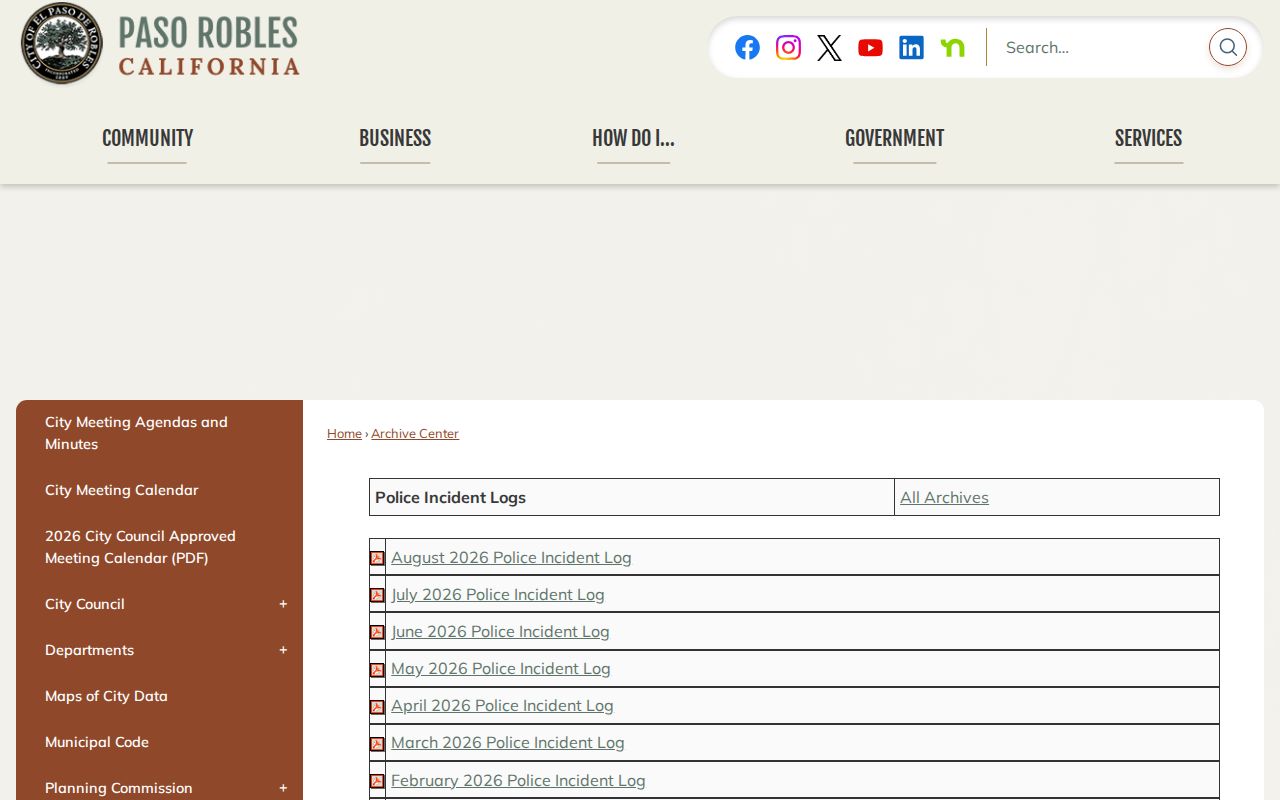
The archive sorts official city logs by date and by older periods. It works as a city activity source. It is not a live custody roster. A booking search still runs through the county.
Where Paso Robles Arrests Appear
No single source captures every Paso Robles police contact, booking, custody change, photo, and court outcome. Match the question to the right source first. News coverage comes last, since it picks and chooses among events.
| Channel | Photo? | Status | Best use |
|---|---|---|---|
| PRPD incident logs | No gallery verified | Official city | Calls, incidents, citations, and arrest context |
| Sheriff Booking Log | Not in the main table | Official county | Recent county bookings and arresting agency |
| Sheriff custody search | Conditional separate route | Official county | Current custody, bail, charges, and projected release |
| PRPD Records Division | Ask for a specific record | Official city | Police reports and incident material |
| Local news | Sometimes agency supplied | Independent | Event context, never a complete arrest list |
The Sheriff Booking Log states its data runs at least one hour behind. That is a floor, not a schedule. Records post when they post. The date and time selection closes a 24-hour window ending at that point. Each row can display booking number, ID number, name, sex, date of birth, booking date and time, charges, location, and agency. Booking charges and bail can change later.
Find a Paso Robles Booking
Start with details that separate lookalike records. A full name, a likely incident date, and a known location beat a broad name-only search every time. Keep the city incident question and the county booking question apart throughout.
- Open the official PRPD incident archive and check the likely event date.
- Use the Sheriff Booking Log for the relevant 24-hour endpoint and choose PRPD as agency when useful.
- Search the official Who's In Custody roster if the key question is whether the person remains held.
- Compare booking number, booking time, arrest location, and arresting agency rather than relying on a name alone.
- Request the city police report or county booking record if the web sources do not answer the question.
The county roster filters by inmate ID, booking number, name, gender, date of birth, age, booking date, projected release date, and bail. Someone released may drop off the roster while the booking record still exists. The San Luis Obispo County arrest guide covers that county-wide distinction and the official photo-request path.
Why Paso Robles Records Differ
PRPD's daily log and the Sheriff booking system serve different jobs. The city log records police activity. The county system records jail intake and custody. Transport and intake push the booking timestamp past the arrest, and the Booking Log carries its own stated delay. A citation or a release before county intake can leave a city record with no county booking at all.
The gap grows for older searches. PRPD keeps historical monthly archive groupings. The county's raw booking feed shows only about thirty days of history online, and that web depth is not a retention promise. When an older row disappears, request the record. A rolling feed that no longer displays an arrest never means the arrest failed to happen.
Request Paso Robles Arrest Records
PRPD's Records Division handles requests for city police reports. It also covers incident log copies and related city-held material. Give the report number if you have it, plus the date and location. The Helpful Forms page lists the daily log at the police department, with copies at $7. A city FAQ warns that a report may stay unavailable until District Attorney review. Paying or filing does not guarantee same-day release.
- Decide whether the record sought is a PRPD incident report or a Sheriff booking record.
- Give PRPD the report number, event date, location, and a focused description.
- Ask whether review or a legal restriction affects release.
- For jail intake or a specific booking photo, use the Sheriff records route with the booking details.
Paso Robles Police Department
Records Division
900 Park Street
Paso Robles, CA
Paso Robles police publish no booking-photo gallery for the public. Ask about a photo one arrest at a time. Tie the request to a specific booking or incident report. Expect conditions. Juvenile files, victim information, and active investigative material stay protected. Privacy rules can close off parts of any record. For a PRPD police report or a Sheriff booking photo, the Superior Court clerk is the wrong window entirely.
Paso Robles Arrest News
A log row gives you a name and a timestamp. News stories give you the story. The Paso Robles Daily News runs North County arrest coverage. It has printed agency-supplied photos with its individual reports. KSBY and The Tribune track Paso Robles investigations and court proceedings too. None of them functions as a live custody list, though. Editors pick what to publish. A missing story tells you nothing about who sits in jail right now. The Paso Robles Daily News home page is the paper's own front door. It leads to the latest coverage.

Read a dated story for what the agency said that day. Then check the Sheriff or the court for current custody and case status.
Private arrest indexes sit far from the source. They can lag after an official feed drops an entry. They can miss a fresh arrest too. Names and booking photos from those services do not appear here. Confirm anything you find. Check it against PRPD, the Sheriff, and the Superior Court. That matters most when a story predates a later release, dismissal, or change in charges.
After a Paso Robles Arrest
An arrest is a start, not a finish. County booking data may list a docket number, the next court date, and a court department. Charge descriptions and bail can appear too. Those fields reflect the moment of booking. Dates shift, bail moves, and charges get amended, dismissed, diverted, or never filed at all.
For the official outcome, go to the San Luis Obispo Superior Court Criminal Division. The court routes public documents through re:SearchCA or a written request. It warns that some case information may be missing. Its clerk cannot hand over the underlying PRPD police report. Keeping those roles straight keeps a city incident entry from standing in for a verdict.
Custody can shift before the court file catches up. The Sheriff roster posts a projected release date. Treat it as a projection, not a promise. Eligible records link to California's VINE system for custody alerts. VINE flags releases, transfers, and other status changes. It is no substitute for calling the jail or watching for a court notice.
State and federal custody live elsewhere entirely. California Men's Colony is a state prison inside San Luis Obispo County. Yet PRPD books city arrests into the county jail, not there. Someone moved into CDCRR custody shows up through the state system instead. Federal Bureau of Prisons and immigration detention records also fall outside the Sheriff Booking Log. Those boundaries explain many empty searches without erasing the original Paso Robles incident.
Build your timeline the simple way. Save the source date and every identifier shown. Then compare the later court entry against the original PRPD and Sheriff records.
Public Record Search
Sponsored Results