
SLO County 24 Hour Arrests
The Sheriff's office posts an official Booking Log covering recent adult bookings in San Luis Obispo County. Three controls drive it. You pick a date, an hour, and an agency. The hour works as an endpoint. The search then reaches back one full day from that spot, so a 3 p.m. selection closes the window at 3 p.m. and opens it the day before. An "All Agencies" option pools every department found in the booking data.
One caution belongs here. This is a booking feed. It does not capture every arrest in San Luis Obispo County. Citations, pre-intake releases, juvenile cases, and state or federal custody all move down other paths. A city officer can make the arrest while the county jail creates the booking record. Agency and location fields help explain that split, but booking time is not the exact arrest time.
Check SLO County Arrests Today
The Booking Log fits a recent-intake question rather than a custody check. Its endpoint design makes the hour matter. Choose the wrong hour and the window can slide right past the booking. Search the official source this way:
- Open the Sheriff Booking Log and note its delay warning.
- Select the date and hour that should end the 24-hour period.
- Leave “All Agencies” selected for countywide results, or choose an agency when the arresting office is known.
- Compare the booking date and time, agency, and location before opening charge details.
- Use the current-custody roster if the key question is whether the person remains in jail.
A name alone can mislead. Spellings vary, and two people can share a name. A booking number or inmate ID pins down the exact person when you have one. The San Luis Obispo County recent-arrest hub sorts out how the roster, booking record, court file, and records request each answer a different question. Court status belongs to the Superior Court. Never read a booking charge as the case outcome, and for the on-screen controls plus the county warning, the official Booking Log interface puts both in one place.
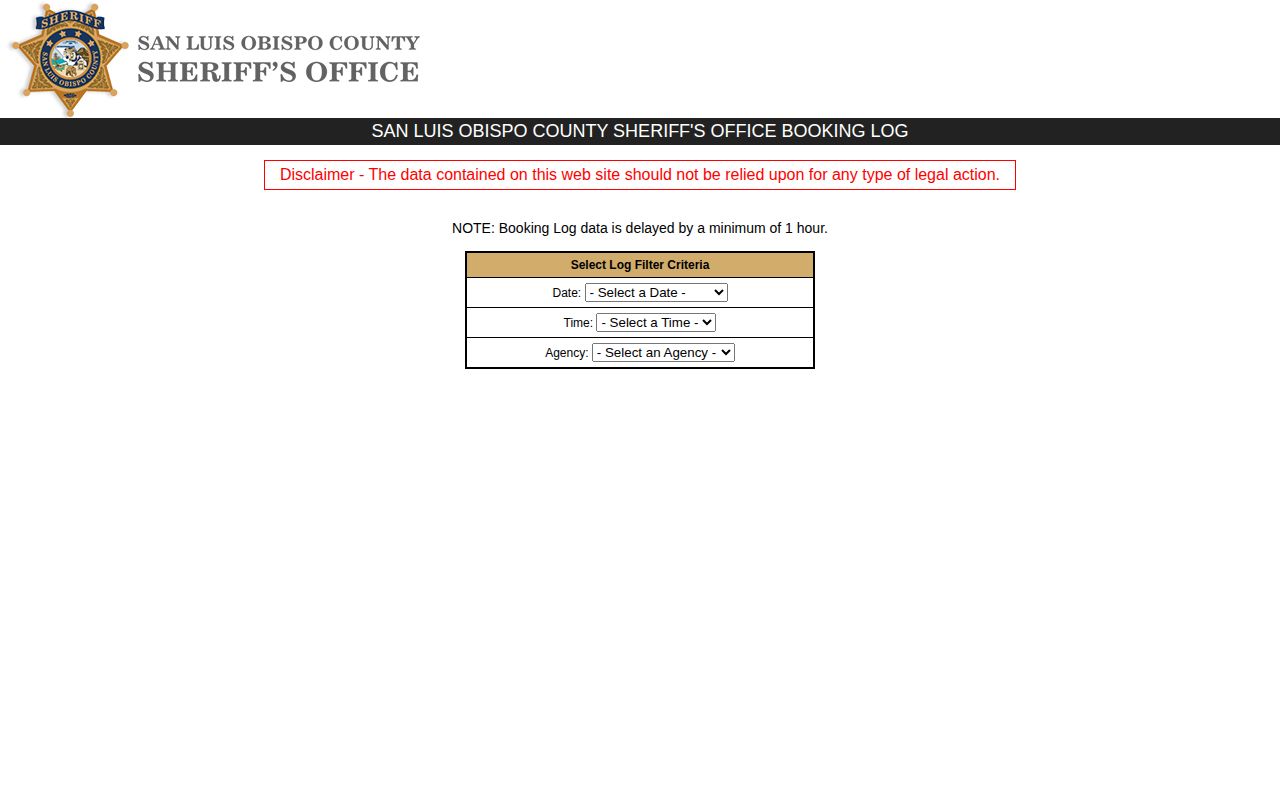
The county page shows the booking filter. It is not a third-party list. Names stay local. The county log is the source.
SLO Arrest Window Fields
A San Luis Obispo booking report groups several kinds of arrest data together. Identity comes first. Booking details, charge descriptions, and the arresting agency round out the record. Each field reflects what the county knew at the time of booking, so it stands apart from any later court file.
| Field | What it means |
|---|---|
| Booking # and ID # | County identifiers for the booking event and jail record. |
| Name, sex, DOB | Identity fields shown by the booking source; date of birth is sensitive and should be handled with care. |
| Date/Time | The jail booking timestamp, which may be later than the arrest itself. |
| Charges | Codes and descriptions known at booking. They may later be amended, reduced, dismissed, or not filed. |
| Location | The arrest location recorded with the case, not necessarily the detention site. |
| Agency | The Sheriff, city police, CHP, or other office tied to the booking case. |
Populated records can carry statute or code type, arrest agency, arrest location, and even a court date. Photos are different. The log offers no dependable public gallery. The Sheriff keeps a separate per-booking photo route, which can report that an image is unavailable, so photo access stays conditional and works best when tied to one specific booking.
Verify a New SLO Booking
A booking too new for the log calls for a different tool. Switch to the official Who's In Custody search. The odd spelling in its web address is the real Sheriff path. Search with the most precise identifier you have. The roster accepts inmate ID, booking number, name, gender, birth date, age, booking date, projected release date, and bail filters. Filters narrow a search fast.
A result can show booking date and time, projected release, bail, charge descriptions, bond number, and arresting agency. The Sheriff cautions that booking-time charges and bail can change. Do not build legal action on the roster. A missing name proves nothing either. The person may have been released, transferred, booked under data not yet posted, or never entered county custody at all. For a present-custody question, the Sheriff custody search is the stronger source, answering who sits in the county jail right now.
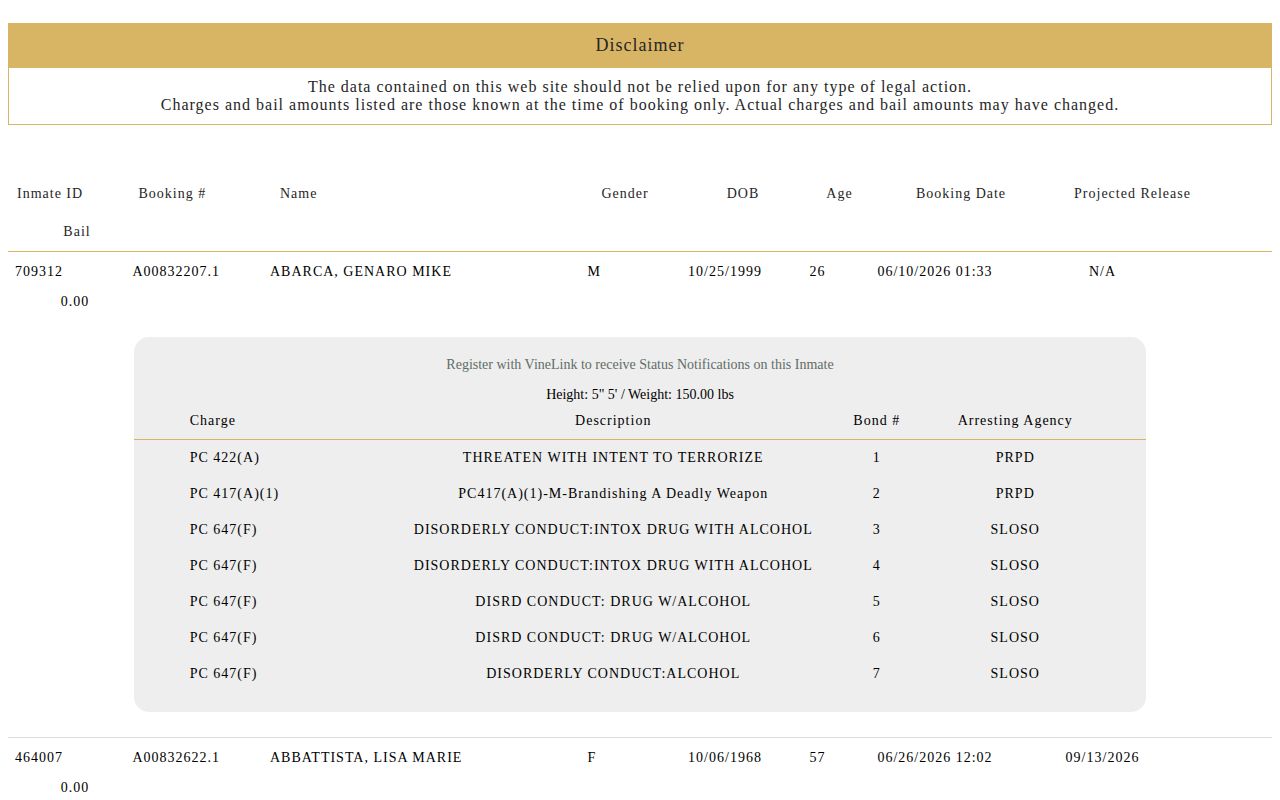
The form opens blank. Its fields are official. No booking photo shows. A name search fills them in.
When SLO Arrests Appear
An arrest sets off a chain of agency steps. Transport, jail intake, identification, and medical and safety screening all come first. Only then is the booking record created and the public log updated. The stated one-hour delay is a floor. Nothing posts on a guaranteed clock. Weekends, holidays, a correction, or a system change can stretch the wait further.
Each source keeps its own clock too. A city incident log records police activity. The Booking Log records the county intake event, and the roster answers who is in custody right now. News can run off an agency release before or after either database moves. Conflicting dates are common. Compare field labels and source times.
A filter choice can also hide a booking. An agency-only search drops records tied to other departments, even for an arrest made in the same city. Run "All Agencies" first. Save a narrow agency pass for once the arresting office is known. Also record the chosen date and hour with any result, because a later endpoint covers a different set of 24 hours, and that note keeps an apparent change from reading as a correction or release.
Note: Select an endpoint after the expected booking time, then recheck later if the minimum delay has not passed.
SLO Arrest Confirmation Fallbacks
Sometimes the online check leaves a custody question open. Then the county jail information line, 805-781-4600, is the direct answer. A booking that has dropped out of the live view is not gone. The county PRA/Data Requests page handles those. It routes arrest, inmate, custody, criminal, and related Sheriff requests. Give the person's name, a rough date range, and the location. Add any booking, case, or incident number you have. Expect no fixed fee or delivery time; the county page makes no such promise.
Booking events spread across many days. Those point to the San Luis Obispo County Police Blotter instead. Release and transfer notices for one specific person run through VINELink, a separate notification service. Neither one carries a court disposition. That recorded outcome lives only in the court record. The court itself is the source. The County Jail Information page lays out the official jail route. It also explains the role of the San Luis Obispo County Jail.
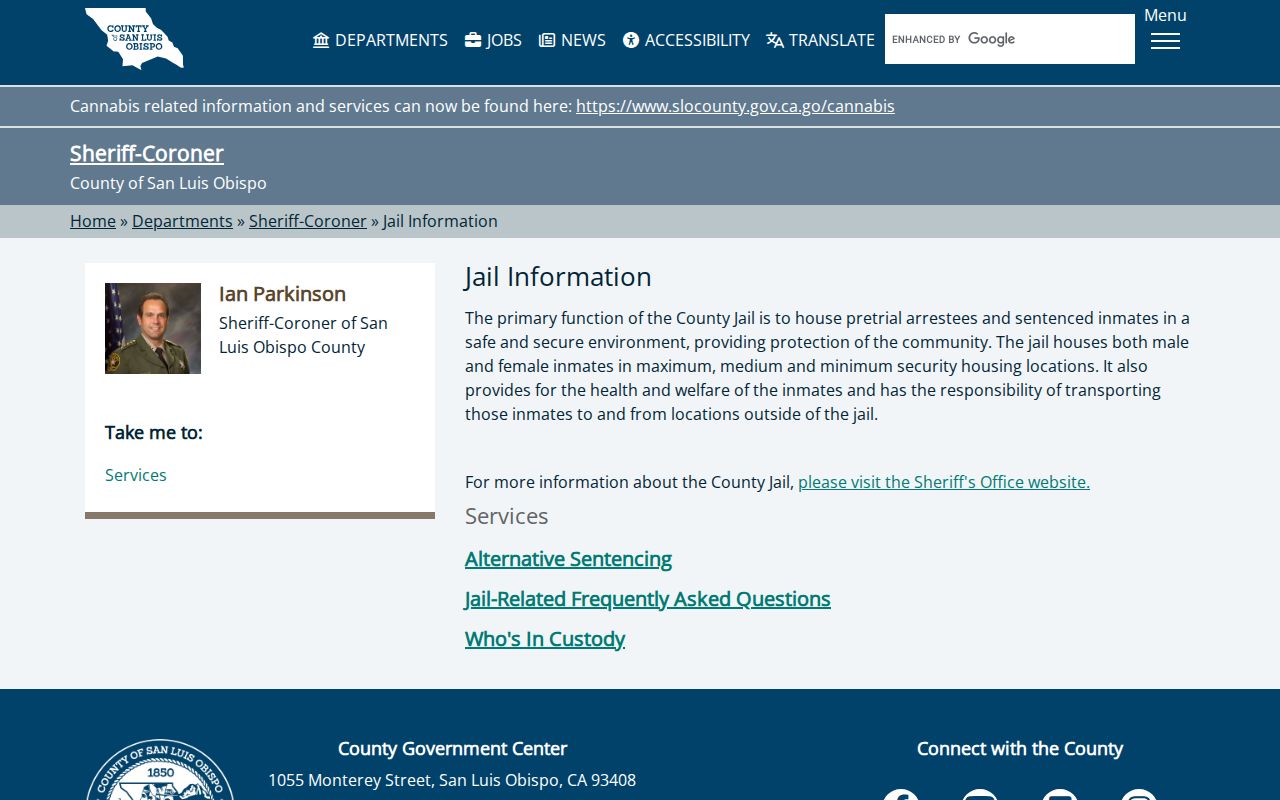
The county page does one job well. It confirms that a custody link belongs to the local adult jail system. Someone released yesterday can vanish from a current-custody search. The booking record still sits inside the Sheriff's records system under its own access rules. A transfer to California state prison moves the person into CDCR's offender search. That sits outside the county same-day feed entirely. Federal and immigration custody each run on separate systems too. These boundaries explain why an empty screen is never proof that an arrest never happened. Treat a no-result as a routing problem first. Make it a records question second.
SLO Arrest Charges and Court
A booking charge is simply what gets written down at intake. It is an intake label, nothing more. Prosecutors may decline it, keep it, or file something different. Courts can dismiss charges. Bail or release terms can shift as a case moves along.
Booking photos work the same way. A mugshot documents one stage: intake. Confirming a recent arrest never requires a gallery of images, and the official source may withhold or lack a photo for a given record.
Read the one-day log and the custody roster side by side, but keep them apart. One pins a booking event inside a rolling window you choose. The other tells you whether that person is still in county custody. A release, a transfer, or a correction can change what one screen shows. So can a filter choice on your end. Either can push the two screens into disagreement. Note the time of each check. Compare the booking number and the arresting agency before assuming anything. When a real conflict appears, ask the Sheriff to resolve it. For older arrests, use a narrow records request. Don't stretch a current no-result into a bigger claim.
Public Record Search
Sponsored Results